Evaluate Profiles
Use public work signals to evaluate candidate profiles.
A DINQ candidate profile brings public information from multiple sources into one structured view. It is designed to help you understand whether a candidate is relevant, credible, and worth contacting.
Use profile details to answer:
- Does this candidate's real work align with the role?
- Is their public history supported by tangible evidence?
- Do their projects, papers, or contributions match the technical requirements?
- What specific context could help you write better outreach?
Enriched profiles
An enriched profile may include professional background, public links, GitHub activity, papers, projects, education, work history, social profiles, contact information, and AI-generated notes.
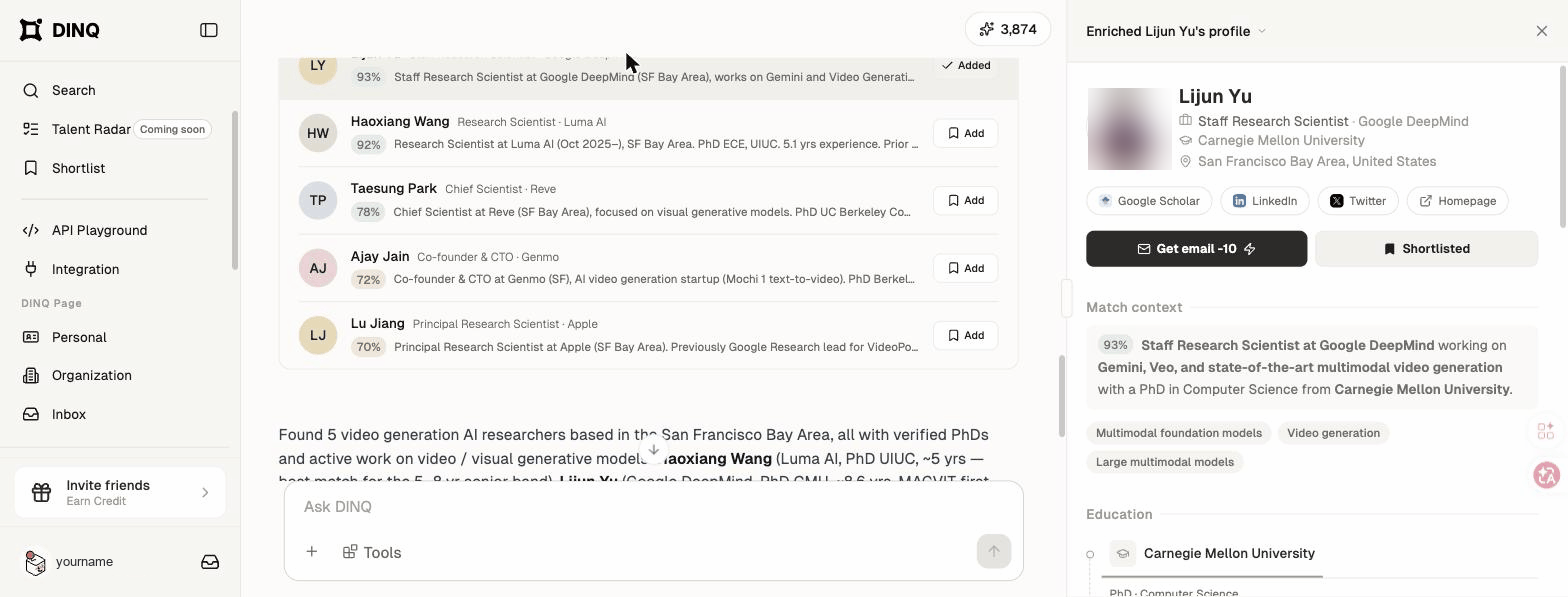
DINQ profiles are designed for review, not automated decision-making. Always use the source links and your own hiring criteria before making decisions.
Understanding Match Scores
Match Scores help indicate how closely a candidate appears to match your search. They are generated from multiple public signals rather than simple keyword matching alone.
Use Match Scores as a starting point. A high score can help you prioritize review, but it should not replace your own evaluation of the candidate's work, experience, and fit.
What to review
When reviewing a profile, look across several areas:
- GitHub: Primary tech stack, project quality, contribution patterns, repository activity, stars, downstream usage, and open-source impact.
- Papers and research: Research direction, paper quality, citation trends, h-index, conference placements, and whether the work is theoretical or applied.
- LinkedIn and work history: Companies, roles, tenure, organization scale, career trajectory, and consistency with public technical output.
- Projects and work: Live products, demos, personal websites, standalone open-source projects, and other public proof of work.
- Contact and outreach context: Available contact information and specific hooks you can reference in a message.
Cross-verification tests
Avoid relying on a single data point or job title. Cross-check claims against public evidence.
- Infrastructure test: If a candidate appears to have LLM infrastructure experience, check whether their GitHub repositories or contributions show relevant code, systems, or framework usage.
- Research test: If they appear to be an AI researcher, review whether their papers, citation metrics, co-author networks, and conference venues support that expertise.
- Seniority test: If they look senior on paper, look for evidence of project ownership, architecture decisions, leadership, or complex collaboration.
- Startup builder test: If you need a zero-to-one builder, look for signs that they have launched projects, products, repositories, or technical systems from scratch.
Talent Analysis
Talent Analysis turns public profile links into structured insights across engineering, research, and professional background.
You can use Talent Analysis to:
- Review an engineer's or researcher's public technical capability before an internal discussion.
- Find specific project, code, or paper details to reference in outreach.
- Compare cross-platform profiles in a more consistent format.
- Give hiring teams clearer evidence for candidate review.
Talent Analysis relies on publicly available records. The depth and accuracy of generated insights depend on the availability and freshness of the source data.